Fundraising
Industrial M&A: a competitiveness lever, under certain conditions

Published on 09/15/2026
Copy link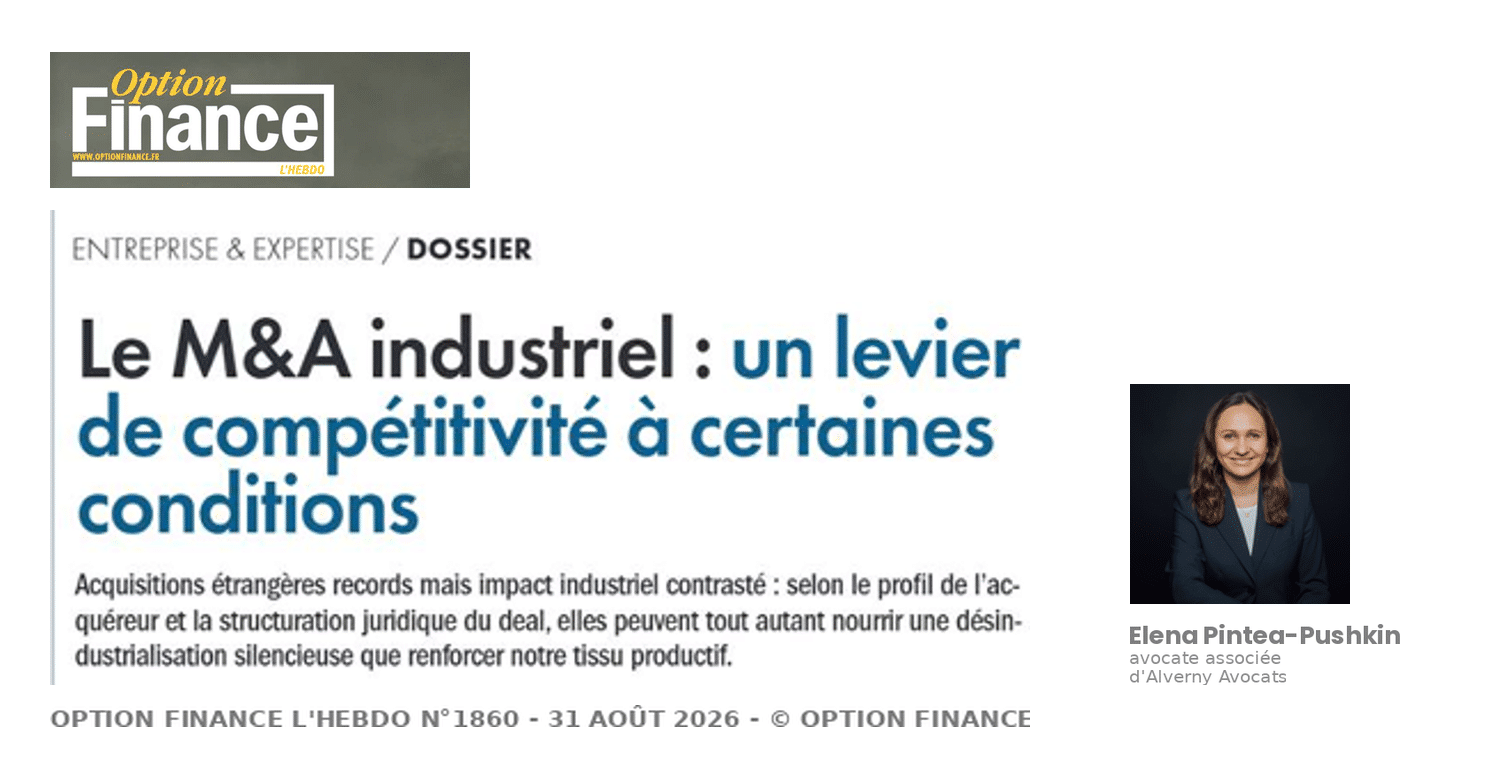

Record foreign acquisitions but a mixed industrial impact: depending on the acquirer’s profile and the legal structuring of the deal, they can just as easily feed a silent deindustrialisation as strengthen our productive base.
By Elena Pintea-Pushkin, Partner, d’Alverny Avocats
1. “Inbound” M&A does not tell the whole story about its industrial impact
Every year, law firms and public authorities brandish the same statistics: France remains one of Europe’s leading destinations for foreign investment, and inbound industrial M&A is one of its pillars. On that basis, every acquisition of a French site by a foreign investor is spontaneously read as a victory.
Yet this macroeconomic reading obscures a more granular reality: the industrial trajectory of the companies sold three to five years after the transaction. Some deals translate into transfers of know-how, productive investment and a strengthened foothold in value chains. Others lead, on the contrary, to gradual closures, the loss of decision-making centres, or the simple transformation of French sites into subcontractors with no autonomy and no capacity to develop.
2. This is not economic patriotism, it is legal design
Faced with these contrasting trajectories, the reflex is often to respond in terms of “economic patriotism”: should foreign investment be screened more tightly, or even blocked? This binary approach pits openness against protection, whereas the real issue lies elsewhere — in the way transactions are structured and negotiated.
The tools already exist to make M&A a lever for reindustrialisation rather than a vector of deindustrialisation. They are both legal and financial: conditions and commitments given in the context of foreign investment control, clauses on the maintenance of operations, investment or employment, governance designed to preserve decision-making centres in France, and contractual mechanisms that genuinely incentivise the acquirer to keep its promises. These tools are nonetheless under-used — not because they are legally out of reach, but because they arrive too late in the process, once the deal’s economic logic has been settled and the industrial parameters are treated as non-negotiable.
3. Three acquirer profiles, three industrial rationales
Not all inbound industrial M&A deals are alike. Behind the generic label “foreign investor” lie at least three typical profiles, driven by radically different rationales.
3.1. The industrial strategist who integrates
The first profile is the integrating strategic buyer: an industrial player from the same sector or an adjacent one, seeking to embed the French site in a global value chain. Its rationale is long-term: gaining access to a market, a technology or scarce skills. When it plays by the rules, it can turn a French site into a European — or even global — bridgehead, with substantial investment. But such integration almost always comes with change: product ranges are consolidated, plants are specialised, support functions are reorganised. The risk is less immediate closure than the gradual shift of high value-added functions towards the group’s home country. For this type of acquirer, the legal challenge is to secure the French site’s place in the global industrial architecture: commitments on volumes, on capacity to be maintained, on R&D activities kept locally, and on decision-making centres based in France.
3.2. The fund that optimises
The second profile is the investment fund, whose primary rationale is financial. It thinks in terms of holding period, returns and future exit — sometimes with genuine industrial understanding, sometimes much less. Its action focuses on optimisation: restructurings, refocusing, disposals of non-strategic assets, margin improvement.
This type of strategy can be virtuous where it allows an under-invested industrial group to be brought back up to standard, relieved of peripheral activities, and turned into a more robust player. Here, the law must concern itself with the industrial trajectory over the holding period: productive investment covenants, the maintenance of certain lines or sites, safeguards on disposals of key assets, and enhanced reporting enabling stakeholders to monitor performance of the commitments.
3.3. The consolidator that rationalises
The third profile is the sector consolidator, often already present in France, which acquires in order to combine operations, rationalise capacity, and eliminate overcapacity or weaker competitors. Its rationale is industrial, but it can destroy jobs or local production capacity, precisely because value comes from rationalisation.
For this profile, the legal tools to be deployed concern the territorial and sectoral footprint: commitments to maintain operations at certain sites, industrial conversion obligations, investment plans in forward-looking technologies or segments, and a timetable framing the rationalisation rather than letting it happen solely at the pace of synergies.
4. The false debate over the nationality of capital
A frequent confusion consists in correlating industrial risk with the acquirer’s nationality. That is an analytical error. A French fund can optimise an industrial asset with the same detachment as a foreign fund; conversely, a foreign industrial group may ring-fence a French site that has become strategic to it, because that site holds technical expertise found nowhere else in its organisation.
The relevant criterion is therefore never nationality, but the structure of the transaction and the holding horizon. This clarification has a direct practical consequence for advisers: it rules out building a negotiation strategy on geographical assumptions, and requires, in every deal, an analysis of the acquirer’s actual economic rationale, regardless of its flag.
5. Legal tools are available, but activated too late
Whatever the category of acquirer, France already has a range of tools to steer the industrial impact of transactions.
Foreign investment control makes it possible to condition certain acquisitions on precise commitments. At the contractual level, acquisition agreements also offer considerable scope: clauses on the maintenance of sites or jobs, investment covenants, obligations not to relocate certain activities, consultation obligations in the event of a planned closure, and financial penalties for non-compliance.
Too often, these discussions only take place at the end of the negotiation, in reaction to social or political concern, by which time the industrial logic chosen by the acquirer is already locked in.
6. Do not close the door — choose the keys
The adviser’s role is decisive here. Identifying the acquirer’s real profile from the very first exchanges, beyond its stated intentions, makes it possible to calibrate the legal structuring accordingly: the intensity of commitments to maintain operations when facing a fund, post-acquisition governance mechanisms when facing a strategic buyer, and clauses preventing asset arbitrage when facing a consolidator.
This upstream characterisation shapes the whole of the rest of the negotiation. The point is therefore not to build a wall against foreign investment, which remains necessary to finance French industrial growth: it brings capital, sometimes export outlets, and sometimes a management discipline the target had been unable to impose on itself. But openness without an industrial compass or appropriate legal structuring amounts to outsourcing to others the decision on our acceptable level of deindustrialisation. By accepting that the law is not merely a safety net at the end of a process but a design tool from the outset, inbound industrial M&A can become an instrument of chosen reindustrialisation rather than a driver of silent deindustrialisation.