Intellectual Property | Innovation
IP Infringement: 3 Questions for d’Alverny Avocats in La Semaine Juridique.


Published on 07/16/2026
Copy link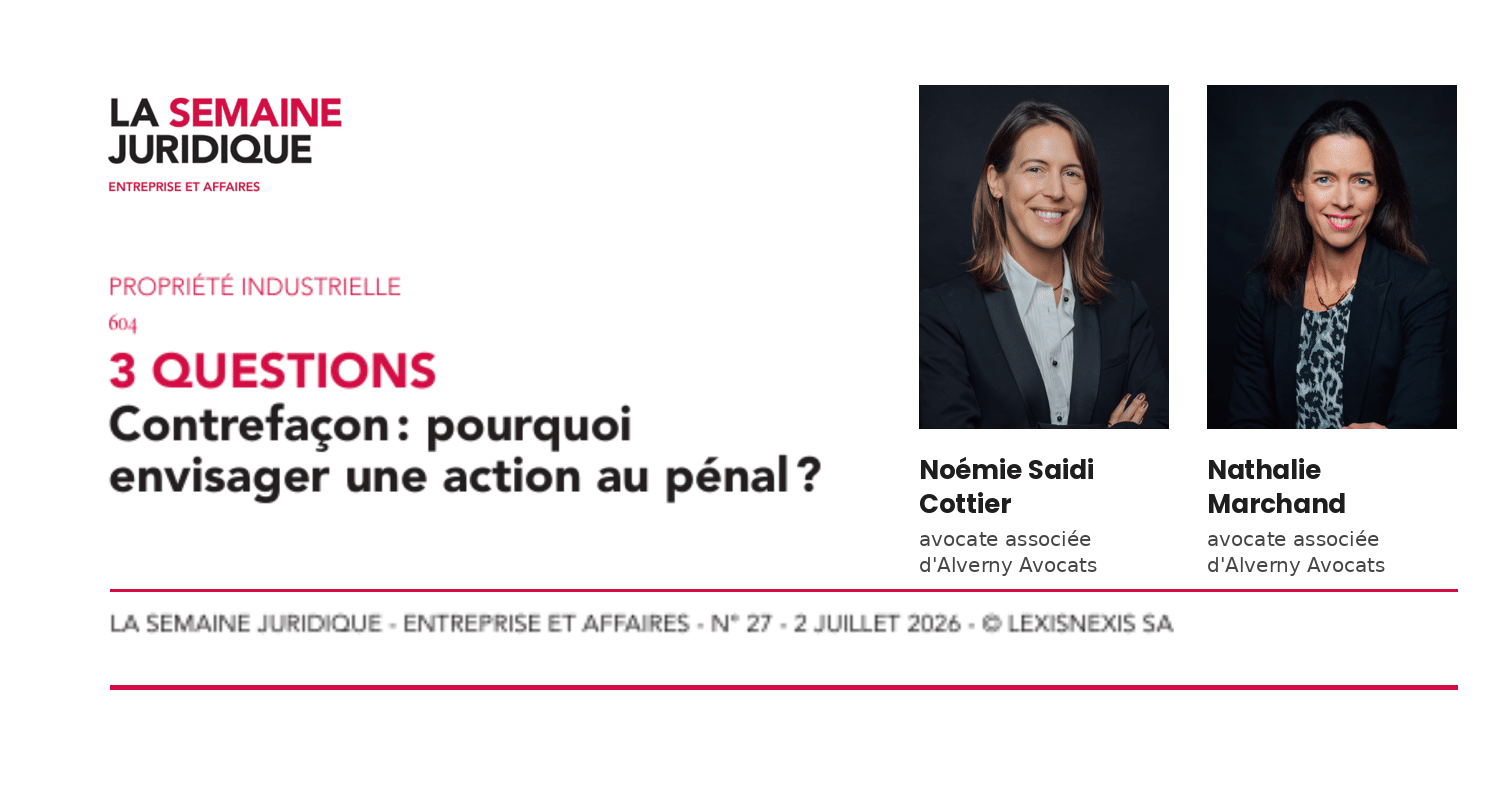

IP Infringement: Why should you consider criminal proceedings?
On the 18th of June 2026, in Marseille, the authorities destroyed more than 206,000 counterfeit products, with an estimated value of EUR 42,000,000, seized at the “Marché du Soleil”, which is described by the French public prosecutor as the “French hub for counterfeit goods”; eighteen defendants, including public officials suspected of corruption, are to be tried on June 22. This news raises questions as to the usefulness of criminal proceedings, whereas in practice right holders generally give preference to actions brought before civil courts. Though, with certain infringers or infringement schemes, criminal proceedings may afford major strategic advantages.
➡️La Semaine Juridique n°27 du 2 juillet 2026
By: Noémie Saidi-Cottier and Nathalie Marchand, partners at d’Alverny Avocats
1. Practically speaking, how should criminal proceedings be brought?
Criminal proceedings may be initiated in two ways: either by filing a criminal complaint or by issuing a direct summons.
The “plainte simple” (simple complaint) seizes the public prosecutor’s office, which shall decide whether to initiate prosecution (or not). The “plainte avec constitution de partie civile” (complaint with application to join proceedings as a victim) allows to refer the case to an investigating judge and to initiate a judicial investigation, if for a three-month period from the filing of the simple complaint, the public prosecutor’s office has done nothing. The complaint is frequently used, in particular when the right holder intervenes in support of customs authorities’ action.
Alternatively, “citation directe” (direct summons) enables the right holder to summon the defendant directly before the criminal court, without the involvement of the public prosecutor’s office. However, this autonomy is not without constraints: in the absence of a prior investigation, everything depends on the summon and case put together by the victim, which must clearly identify the person implicated, precisely characterise the facts, and adduce evidence of both the material and the intentional elements of the offence. Direct summons is primarily of interest in cases where counterfeiting is obvious and the counterfeiter is readily identifiable.
In other situations, it is often more appropriate, from a practical standpoint, to refer the matter to the public prosecutor’s office, so that it conducts an investigation, initiates criminal proceedings, and summons the defendant to appear at the hearing. When a legal entity is involved, it must identify the perpetrator of the offence, namely the body or the representative who acted on behalf of the company.
The criminal proceedings may nonetheless only succeed if the offence is established in both of its elements, the material and the intentional elements. Unlike in civil proceedings, where good faith is irrelevant, the intentional element is often inferred from the circumstances of the case.
In practice, criminal proceedings are appropriate in trademark matters, against an identified counterfeiter, and even more where large‑scale operations and organised criminal networks are involved.
2. In practical terms, what are the advantages of bringing criminal proceedings?
The main benefit lies in the scope of the investigatory and seizure powers, as well as in the severity and exemplary nature of criminal sentences.
Conducted by the police, the customs authorities and the public prosecutor’s office, criminal investigation allow to use extensive investigatory measures with no equivalent in civil proceedings: searches, seizures of stock and servers, telephone interceptions, surveillance measures, banking disclosure orders, European cooperation, etc. Whereas civil proceedings rely essentially on the infringement seizure (“saisie-contrefaçon”) and on the disclosure of documents ordered by the civil court, criminal proceedings afford broader, and often faster, access to evidence.
All of these prerogatives may make it possible to uncover document and prosecute infringements which the rights holder, acting alone, would not have been able to fully apprehend, particularly when facing structured networks, sometimes linked to serious criminal activities, such as the financing of terrorism.
The system governing criminal seizures is likewise largely favorable: it authorizes the seizure and confiscation not only of the disputed goods, but also of assets and property that were used to commit the offense or that derive therefrom, thereby enabling the recovery of the profits from the infringement.
Lastly, the deterrent effect of criminal proceedings is decisive. The counterfeiter, whether an individual or a company, is exposed to significant criminal and customs fines, to a non-negligible risk of pre-trial detention and imprisonment, as well as to additional sentences (e.g., prohibition on carrying on business, closure of the establishment, publication of the decision) and to a mention on their criminal record.
This risk exists for companies but also for their managers who can be held personally liable when their involvement in the case is established. For example, in a case concerning the possession of counterfeit goods, a company and its manager were sentenced, the former to a fine of €15,000 and the latter to a suspended prison term of 10 months, and both of them, jointly and severally, to a custom fine and damages (Cass. crim., Sept. 10, 2025, No. 24-81.914: JurisData No. 2025-014746; Propr. industr. 2025, comm. 79, note N. Binctin).
3. What can be expected regarding compensation?
The other traditional obstacle to initiating criminal proceedings lies in the perception that damages awarded would be lower than those granted by civil courts. However, when ruling on damages, criminal courts apply the same criteria as in civil matters (in particular Articles L. 331-1-3 and L. 716-4-10 of the IP code) and are required to justify their decision both as to the method adopted (according to one or other of the alternatives provided for by the IP Code) and as to the amount awarded (Cass. crim., 15 Feb. 2023, No. 21-84.417. – Cass. crim., 09 Oct. 2025, No. 24-81.914, cited above).
Thus, in a case involving a national network engaged in the counterfeiting of luxury handbags, the court of appeal awarded damages amounting approximately to €625,000 in respect of the profit generated by the infringement and the loss of royalties (Cass. crim., 27 May 2025, 23-86.955: JurisData No. 2025-007951; Propr. industr. 2025, note 64, N. Binctin; Comm., com. électr. 2025, note 72, P. Kamina).
It is furthermore possible to obtain full compensation for the damage suffered, including the acts carried out outside France. The Cour de cassation (French Supreme Court) has indeed recently held that the criminal court of the location where the issuer of infringing content is established, when seised to rule on civil damages, may award full compensation, including for infringing content consulted abroad (Cass. crim., 18 March 2025, no. 24-81,603: JurisData no. 2025-002870; Comm., com. électr. 2025, comm. 40, P. Kamina; Procédures 2025, comm. 129, J. Buisson).
Lastly, the victim may, as in civil proceedings, obtain reimbursement of the attorney’s fees incurred for the protection of its interests, subject to the filing of supporting documents, so as to enable the judge to rule on this amount as accurately as possible.